


The last quarter of 2026 brings several developments for prospective EB-5 investors and our industry: a push in Washington to extend the Regional Center Program, higher USCIS fees on November 30, an inflation adjustment to minimum investment amounts on January 1, and a noticeably tighter lending environment. Here is a short summary of each.
Washington Update: Advocating for a Five-Year Extension
Third Lake Associates Principal Eren Cicekdagi recently joined the IIUSA Leadership Circle advocacy meetings in Washington, D.C., in support of extending the EB-5 Regional Center Program for five more years, through fiscal year 2032. The program is currently authorized through September 30, 2027.
Over three days, the group scheduled 50 congressional meetings across the Senate and the House, prioritizing members of the Senate Judiciary and Appropriations Committees, senators from states with significant EB-5 investment, and House leadership. The gathering also included remarks from Rep. Maria Salazar (R-FL) and Rep. Lance Gooden (R-TX), and an IIUSA PAC event honoring Senator Chuck Grassley.
Federal agencies are currently funded under a continuing resolution through December 11, 2026. IIUSA is advocating for the reauthorization to be included in the federal funding legislation expected in December.
Two Cost Increases Ahead
On September 30, 2026, DHS published its final EB-5 fee rule. For a new regional center investor, combined USCIS charges rise by $4,275. Shortly after, on January 1, 2027, the statutory minimum investment amounts are scheduled to adjust for inflation.
| USCIS Fees | Current | New |
|---|---|---|
| Form I-526E, regional center investor* | $3,675 | $7,850 |
| I-526E Integrity Fund fee | $1,000 | $1,100 |
| Total initial USCIS charges | $4,675 | $8,950 |
| Form I-829, removal of conditions | $3,750 | $5,000 |
| Minimum Investment | Current | Expected** |
| Targeted employment area (TEA), incl. rural, high-unemployment and infrastructure | $800,000 | Above $900,000 |
| Standard investment | $1,050,000 | Above $1,200,000 |
*Includes the new $75 EB-5 technology fee. The Integrity Fund fee is a separate charge.
**Industry estimates. Official adjusted amounts had not been published as of the date of this blog.
The applicable investment amount is expected to depend on when a properly prepared Form I-526E is filed with USCIS, not when offering documents are signed or funds begin to move. Source-of-funds documentation, subscription and petition preparation take time, so families already considering EB-5 should begin now, but still taking the time needed to evaluate a project carefully.
Real Estate Perspective: Higher Rates Put the Focus on Exit
Borrowing costs have moved significantly higher in recent weeks. On September 16, the Federal Reserve raised its benchmark rate by 0.25% to a range of 3.75% to 4.00%, its first increase since 2023. The 10-year Treasury yield, which anchors most long-term real estate financing, reached approximately 5.3% in early October, its highest level since 2002.
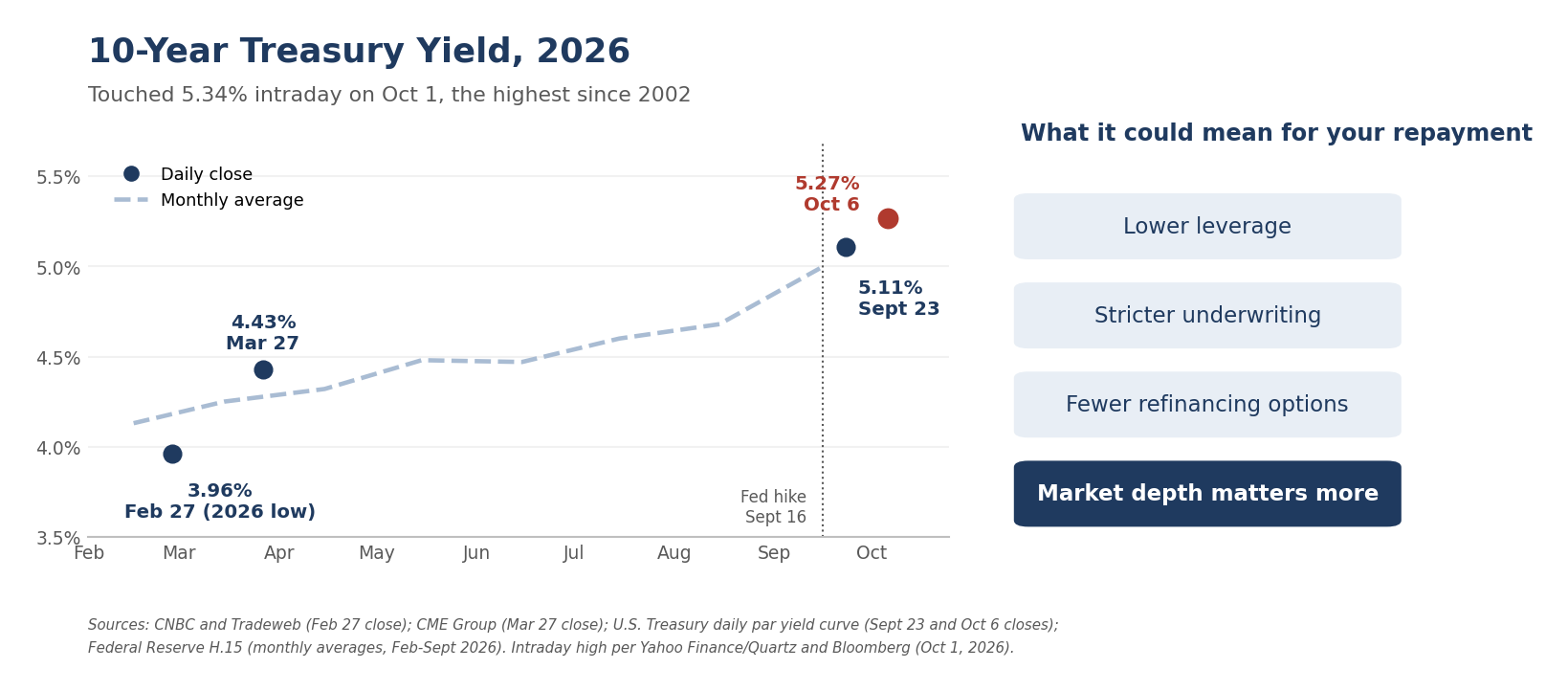
For EB-5 investors, this matters most at repayment. EB-5 capital is typically repaid upon maturity (3 to 5 years) through a refinance or sale of the underlying asset. When rates rise, lenders tend to reduce leverage, apply stricter underwriting and become less willing to extend loans. In that environment, we feel the depth of the local market and the quality of the underwriting carry more weight in whether a project can repay on time.
Rural set-aside visas and priority processing offer certain immigration advantages, and some rural projects may be well structured. In a higher-rate environment, however, smaller and remote rural markets risk having fewer refinancing sources and fewer buyers, which may make exits slower or less predictable. Well-underwritten projects in established, high-demand markets, including those qualifying as high-unemployment TEAs at the same $800,000 level, may have deeper lender and buyer pools when it is time to repay investors. The high-unemployment set-aside also remains current for all countries under the October 2026 Visa Bulletin.
When it comes to project due diligence, our view is pragmatic: test an EB-5 project first as a real estate transaction that a disciplined lender would finance on its own merits, then evaluate its immigration attributes. Questions worth asking include:
- How much equity has the sponsor committed, and does completion depend on EB-5 proceeds?
- Is the capital stack conservative enough to absorb higher rates?
- Is there a credible refinance or sale path in a deep, liquid market?
Source of Funds and Partial Funding Availability
Some investors have decided to proceed but need more time to assemble the full amount, whether to complete a property sale, liquidate RSUs tax-efficiently or receive business distributions. In appropriate cases, a well-documented partial funding arrangement can provide the flexibility to file before the November 30 fee increase or January 1 investment amount adjustment.
Partial funding does not reduce the total EB-5 commitment. The investor contributes an initial portion and agrees, through binding written terms, to fund the remaining balance by specified deadlines. The investor's immigration counsel makes the final determination of whether the arrangement satisfies the "in the process of investing" requirement.
Third Lake's UPC Phase 1 offering, financing the first phase of a 412-unit multifamily development in St. Petersburg, Florida, is currently available at the $800,000 TEA investment level. Because the project is fully capitalized and the EB-5 raise is supported by a full sponsor equity commitment, our EB-5 offerings comfortably accommodate counsel-approved partial funding schedules on a controlled, documented, case-specific basis. Any arrangement must be coordinated among the investor, immigration counsel and the fund manager.
About Third Lake Associates
Third Lake Associates is part of Third Lake Partners’ vertically integrated real estate and investment platform with over $7 billion in real estate investment and developments. We structure our EB-5 funds to the same institutional standard we apply across the rest of our platform, and our EB-5 team brings more than a decade of program experience across more than 2,000 investor families.
Sources: DHS/USCIS EB-5 Fee Rule, Federal Register (Sept. 30, 2026); Federal Reserve FOMC statement (Sept. 16, 2026); U.S. Treasury daily par yield curve rates (Oct. 2026); U.S. Department of State Visa Bulletin (Oct. 2026).
Disclaimer: For general informational purposes only. This post is not an offer to sell or a solicitation of an offer to buy any security, which may be made only through the applicable definitive offering documents, and does not constitute legal, immigration, tax, accounting or investment advice. Private placement investments involve significant risks, including possible loss of principal and lack of liquidity. No EB-5 investment can guarantee petition approval, conditional or permanent residence, repayment or investment performance. Third Lake does not determine whether a particular funding plan or filing strategy satisfies U.S. immigration law. Prospective investors should consult their own qualified advisers before making any decision. Third Lake Associates, LLC, Member FINRA/SIPC.